Pride Montreal 2026: complete guide to the parade, the Gay Village, and events
In brief: Pride Montreal is the largest LGBTQ+ event in Canada and one of the ten largest Prides in the world. In 2026, Pride week culminates with the parade on Sunday, August 9, on René-Lévesque Boulevard. This guide covers everything: official dates, the Gay Village program, accommodation tips, accessibility, safety, and FAQs for first-time participants.

History and Importance of Fierté Montréal
Founded in 1979 as a protest march, Fierté Montréal has evolved into a major cultural festival. The event attracts 400,000 participants in 2025 according to data from the City of Montreal. Its economic impact exceeds 100 million dollars annually, according to Tourisme Montréal.
The international reach is supported by partnerships with organizations like the UN through ECOSOC status. The event remains rooted in the fight for LGBTQ+ rights in Quebec.
See also the complete calendar of LGBTQ+ Pride events in Quebec 2026.

From the 1979 march to Fierté Montréal: three dates to remember
Montreal's first Pride march took place in June 1979. Organized by activist John Banks and the Brigade rose to mark the tenth anniversary of the Stonewall riots, it drew 52 people. For about fifteen years afterwards, celebrations remained irregular.
In 1993, Suzanne Girard and Puelo Deir founded Divers/Cité, partly in response to the 1990 police raid on the Sex Garage party. The organization set up an annual Pride parade and festival that shaped Montreal's celebration for more than a decade.
In 2007, after Divers/Cité withdrew from organizing the community events and the parade, the organization that would become Fierté Montréal took over under the name Célébrations de la Fierté LGBTA. The first festival was held on July 28 and 29, 2007. Keeping these three milestones in mind (1979, 1993, 2007) helps tell apart the first march, the birth of the modern festival and today's organization.
To place the event within the wider season, see the calendar of Pride events in Quebec and the guide to taking part in Fierté Québec 2026.
Official dates 2026 and program for the week
The week takes place from July 31 to August 9, 2026. The main parade is on Sunday, August 9. The Pride Nights offer shows and activities from Wednesday to Saturday.
The main site remains Place Émilie-Gamelin and the surrounding Gay Village. The detailed program can be found on fiertemontreal.com. Activities include panels, concerts, and workshops organized by the community.
Official 20th anniversary programming
The Fierté Montréal Festival celebrates its 20th edition in 2026, presented by TD Bank Group in collaboration with Loto-Québec, with programming showcasing over 150 local artists and the richness of 2SLGBTQIA+ communities.
- Loto-Québec Stage (corner of Papineau and Sainte-Catherine Est): themed evenings every night from 7 p.m. from July 31 to August 9, including drag, queer pop, nostalgia, comedy, cabaret, reimagined folklore, and the closing Zenith day on August 9 following the parade.
- Jardins Gamelin: Nighttime Rendezvous on July 31 and Sami's Cabaret and Friends on August 4.
- Rainbow Market: back from July 31 to August 2, in collaboration with Festival M.A.D. and the SDC du Village, showcasing entrepreneurs and artisans from 2SLGBTQIA+ communities.
- Community Days, presented by Cabenuva: August 7 and 8 on Sainte-Catherine Street East, over 100 booths from community organizations.
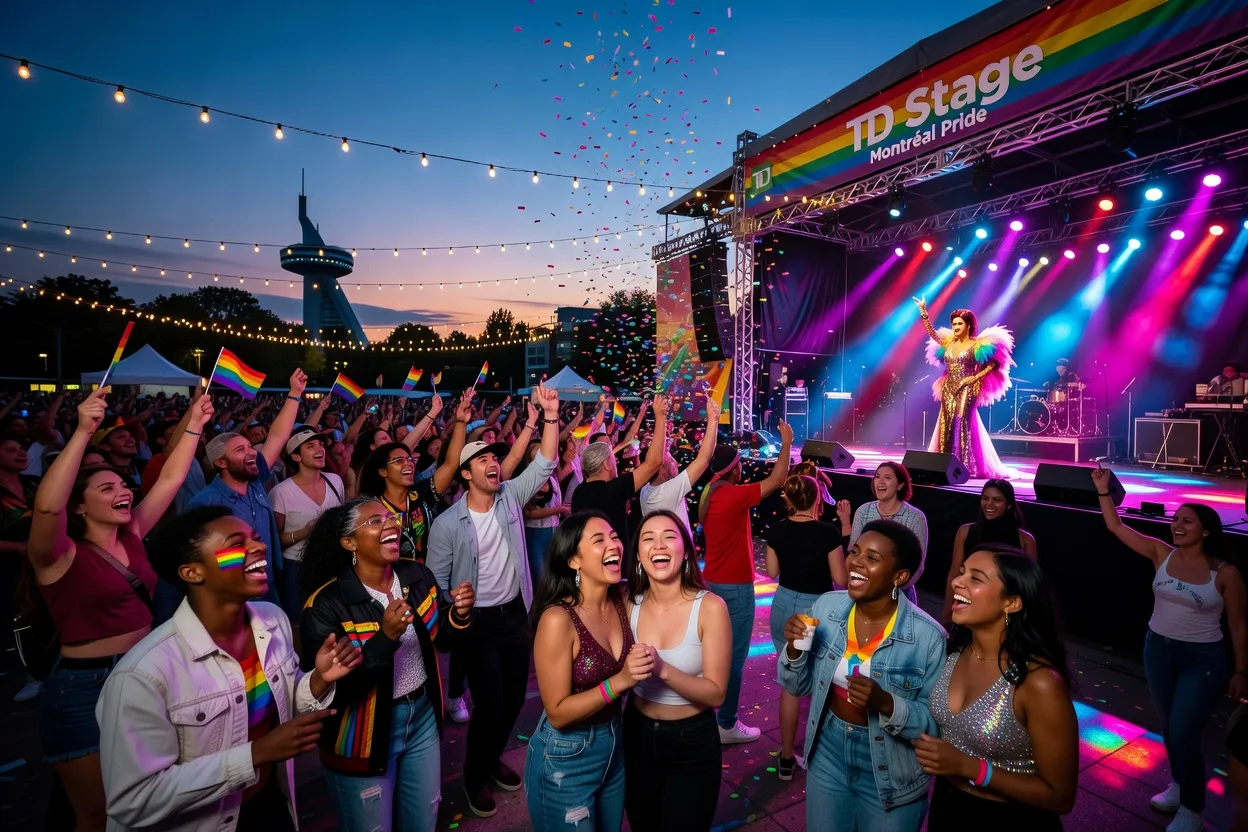
- TD Stage (Olympic Park Esplanade): three evenings on August 7, 8, and 9, including the 100% Drag Night, the 20th Anniversary Show, and the traditional Mega T-Dance after the parade.
- Indoor programming: shows at Théâtre Le National, Club Soda, and the SAT throughout the week.
This year, Fierté Montréal is supporting 21 community projects thanks to the support of Air Canada. More details on the full programming and community initiatives: fiertemontreal.com.
Organizer and contact
The event is organized by Fierté Montréal, a non-profit organization founded in 2007. For questions about programming, contingent registration, or partnerships, visit the official website: fiertemontreal.com.
2026 Pride Parade: Everything You Need to Know
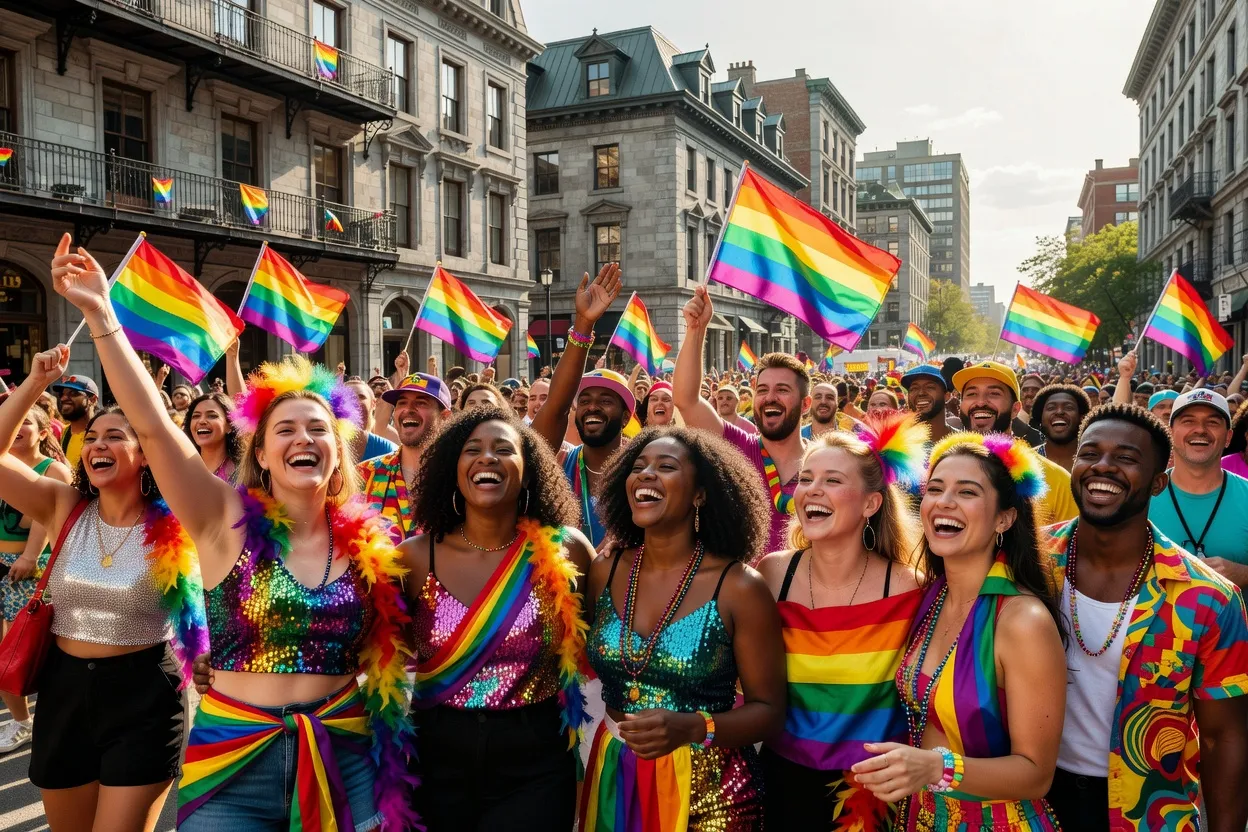
In 2026, the parade takes place under the theme « Shine Together ». The route runs along René-Lévesque Boulevard West to Atateken Street, at the heart of the Village. The start is scheduled for around 1 p.m. Floats, community groups, and political contingents parade each year, gathering tens of thousands of participants.
Access is mainly by public transport: the Lucien-L'Allier, Bonaventure, Guy-Concordia, Peel, McGill and Place-des-Arts metro stations let you reach boulevard René-Lévesque, and Beaudry station serves the Village. Comfortable shoes and sun protection are recommended. The first participants can find additional tips in the top 15 LGBTQ+ events not to miss in Quebec in 2026.
Getting to the parade and planning your day
According to the organizers, the Sunday, August 9, 2026 parade starts at 1 p.m. and follows a route of about 1.9 km along René-Lévesque Boulevard, from the corner of Robert-Bourassa Boulevard to Atateken Street. Fierté Montréal recommends public transit: the Lucien-L'Allier and Bonaventure stations (orange line), as well as Guy-Concordia, Peel, McGill and Place-des-Arts (green line), all give access to the boulevard.
The parade is free. Two areas are reserved for people with reduced mobility to provide an unobstructed view, and an accessible zone with ramps, protective tents and welcome volunteers is set up at Place Ville-Marie. Some activities are offered with Quebec Sign Language (LSQ) interpretation. The organizations Gay & Grey and Aînés et retraités de la communauté gaie lead the parade and have a limited number of golf-cart seats, available by registering directly with them.
At the entrance to festival sites, staff may check the contents of bags and metal detectors are planned; selling and soliciting are prohibited on site. A moment of silence is announced for 2 p.m. during the parade. Up-to-date information is always available on the festival's official website.
Gay Village of Montreal: the must-sees of Pride
The Gay Village stretches along Sainte-Catherine Street East between Amherst and Papineau. The bars Sky, Unity, and Ernest offer terraces and themed evenings throughout the week.
The area becomes pedestrian in the summer. The multicultural atmosphere attracts visitors from all regions of Quebec. Diverse restaurants offer options suited to all budgets.

The Gay Village: a neighbourhood built over a few decades
In the 1970s, Montreal's gay life gradually shifted from the west side of downtown to the Centre-Sud area, around Sainte-Catherine Street East and the Beaudry metro station. The area was first called the "Village de l'Est," then the "Village gai," and finally simply "the Village." It emerged as the main gay commercial and residential hub in the early 1980s and extended as far as Amherst Street, today Atateken Street, during the 1990s.
Beaudry station received its rainbow colours during its renovation in 1999-2000, making it a visual landmark of the neighbourhood. The summer pedestrian mall on Sainte-Catherine Street East, between Berri and Papineau, was made permanent in 2008, after the street closure proved a success during the 2006 Outgames. Artist Claude Cormier's pink-ball installation, titled 18 Shades of Gay, was inaugurated there in 2011.
To extend your visit, see the guide to the the gay community in Quebec: places and events and the overview of LGBTQ+ tourism in Quebec.
Hébergement and logistics for Fierté Montréal
Hotels located near the Gay Village are fully booked three to six months in advance. Airbnb options complement the offer in the adjacent neighborhoods. The STM serves the area via bus 15 and the Beaudry and Papineau stations.
Parking is very limited in the area. Taxis and rideshare services remain available at all times.
Security and Accessibility During Pride
The area is secured by security agents from Pride Montreal in cooperation with the SPVM. People with reduced mobility benefit from accessible vehicles and dedicated areas. The alcohol zone is marked and controlled.
Emergency numbers are broadcast on-site and on the official website. Accessibility for people with reduced mobility receives special attention each year.
LGBTQ+ Socializing and Life in Montreal
Dating apps see a spike in usage during Pride. Inclusive social spaces welcome visitors in the Village. LGBTQ+ hiking groups in Montreal organize activities on the sidelines of the festival.
Check out topsiterencontre.quebec for dating in Quebec.
Practical tips for first-time participants
The site photo-de-mariage.com offers resources on egalitarian marriage.
Sunblock and hydration are mandatory. Comfortable shoes and pride accessories are recommended. Photos must respect the privacy of participants.
Blackface and cultural appropriation are prohibited. Allies are welcome in a spirit of solidarity. Check the guide LGBT community in Quebec: places and events to extend the experience.
Frequently asked questions
When is the Montreal Pride Parade 2026?
The main parade will take place on Sunday, August 9, 2026. The entire week runs from July 31 to August 9. The departure is scheduled for around 1 PM on René-Lévesque Boulevard.
How to get to Fierté Montréal by public transport?
The Beaudry and Papineau metro stations directly serve the Gay Village. Bus 15 complements access from downtown. The STM increases frequency during Pride Week.
Is the Fierté Montréal free?
Access to the parade and public spaces is free. Some shows and indoor events require a ticket. Donations are encouraged to support the organization.
Where is the Gay Village in Montreal?
The Gay Village occupies Sainte-Catherine Street East between Amherst and Papineau Streets. It extends over several blocks around Émilie-Gamelin Square. The area is pedestrian during the summer.
Are there events for families during Fierté Montréal?
Family activities are scheduled at Place Émilie-Gamelin. Dedicated areas welcome children and parents. The official program indicates the schedules for adapted workshops and shows.
How to meet other LGBTQ+ people in Montreal during Pride?
The terraces of the Village and community events promote exchanges. Dating apps are experiencing strong local activity. LGBTQ+ hiking groups in Montreal offer outings on the sidelines of the festival.
Related reading
- complete calendar of LGBTQ+ Pride events in Quebec 2026
- regional pride events in Quebec 2026
- LGBT community in Quebec: places and events
- top 15 LGBTQ+ events not to be missed in Quebec in 2026
- LGBTQ+ travel in Quebec 2026: where to go, when to go and where to stay
- Ballroom and drag in Quebec: interview with a scene organizer